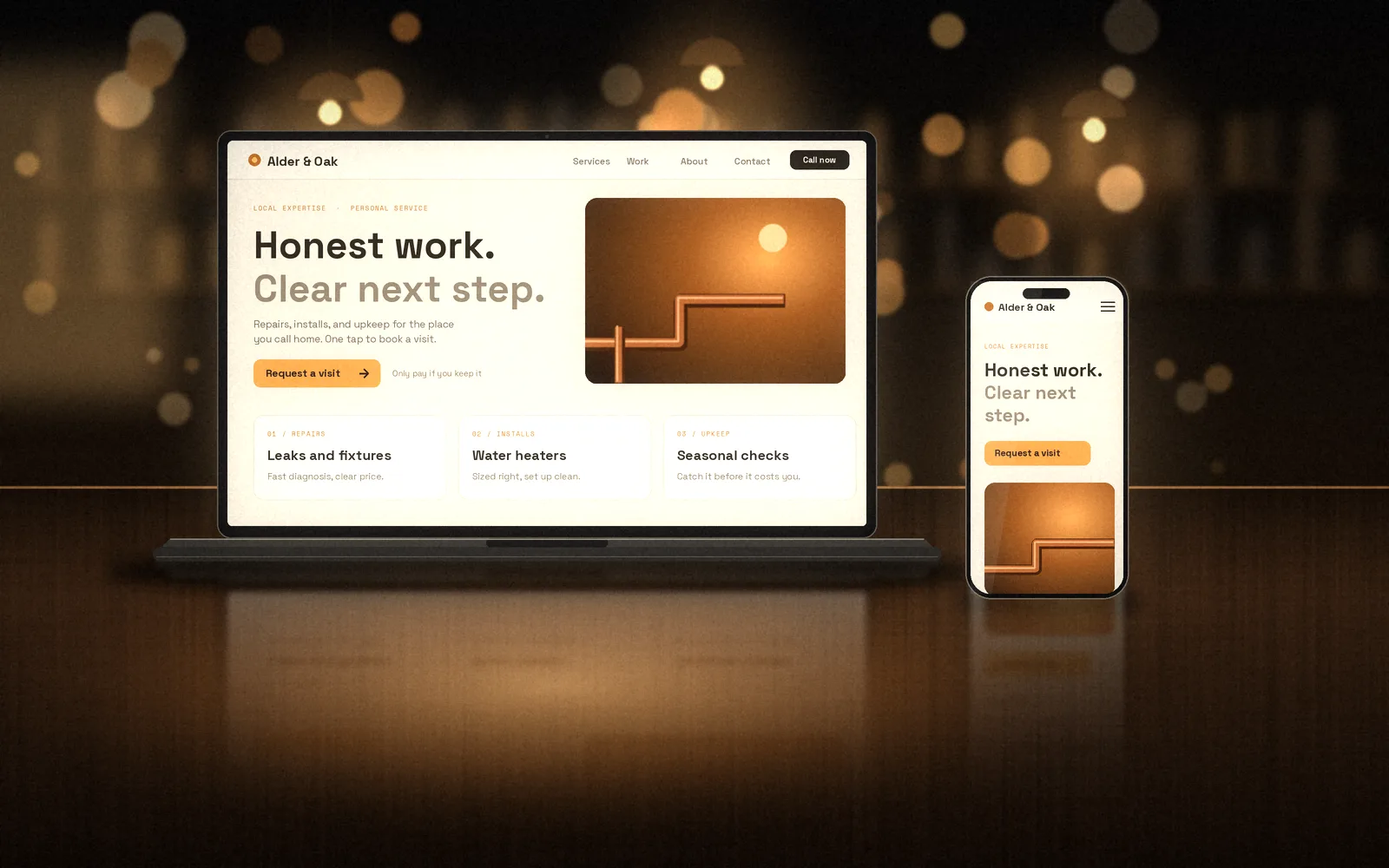
Websites for small businesses
Get found and look legit.
Websites that help customers find and trust your business, and give your tools a home.
Only pay if you keep it.
Where visitors drop off
Three quiet leaksWhere websites actually lose customers.
Most never tell you they left.
- 01 · Before the visit
Invisible in local search
Nearby searches never find you.
- 02 · On arrival
Slow or hard to use on a phone
Slow or clunky on a phone, so they call a competitor.
- 03 · Ready to act
No clear next step
No obvious way to call, book, or ask.
76%of people who search on their phone for something nearby visit a related business within a day.Source: Think with Google (2016)
A site that looks fine isn't the same as a site that converts. The goal is the second one.
Built, not generated
An honest comparisonYou've seen the AI-generated sites.
Here's what's different.
Generic sites tend to look alike: the same gradient hero, the same “elevate your business” copy, and no real reason to call. The tools aren't the problem. Skipping the thinking is.
- Styling
- Typical generated siteTemplate look, stock gradients, interchangeable copy.
- A Sunforge buildVisual direction and copy written from your business, your area, and your voice.
- Local search (SEO)
- Typical generated siteOne thin page and missing markup.
- A Sunforge buildService and area pages, LocalBusiness and FAQ structured data, fast on phones.
- AI answers (AEO)
- Typical generated siteVague marketing language that AI tools can't quote.
- A Sunforge buildClear, quotable answers to real customer questions, so AI assistants can cite you.
- After the form
- Typical generated siteSubmissions land in an inbox nobody checks.
- A Sunforge buildInstant alert, auto-reply, logged, and followed up.
- After launch
- Typical generated siteLaunched and forgotten.
- A Sunforge buildMaintained by a real person you can call.
Unique isn't about looking different for its own sake. It's about looking like your business.
What's included
Five parts, one system
Custom tools
Custom tools that quote
and book customers for you.
Instant price quotes, trip planners, booking and intake forms, built around how your business actually works. Try two of them below.
Customers price the job themselves, any hour.
Next opening: Thu 9:00 AM
Check it off on site. The customer report sends itself.
Job #1042 · AC repair · Alvarez residence
4 left before the report goes out
Illustrative examples · Prices are made up and nothing is sent
What this could look like
Ideas, built to fit each business
- Front deskTalent and speaker agencies
A searchable roster with a shortlist that turns into an inquiry.
- Front deskTravel businesses
A trip planner builds an itinerary around a customer's dates and preferences.
- Front deskLaw offices
Intake screens cases before the call.
- Front deskAuto shops
An "Is my car ready?" page without another phone call.
Have a task you keep doing by hand? Try one free for your business

Try it free for your business
Tell us where customers get stuck or what you keep doing by hand. We'll suggest where to start and set up a working version you can try free.
- 1. Your business
- 2. Your details
- 3. Pick a time
Where are customers slipping through?
Your business choices are saved on this browser.
Names, email, and message text are never saved here.
Try it before you pay
A quick conversation about where customers get stuck, then a working version you use for real. You only pay if you keep it.
Prefer to talk now?
Call 719-424-5680Frequently asked questions
Straight answersIsn't this just another AI-built website?
AI tools are part of how the site gets built, the same way they're part of most software now. They make the build faster. They don't decide what your customers need to see, write copy that sounds like your business, set up search markup correctly, or test every page on a real phone. That part is done by a person, and it's the part that makes a site worth having. You get a site designed around your business, and you own it.
What happens after someone fills out my form?
Four things, automatically. You get an instant alert by email or text. The customer gets a reply right away so they know they were heard. The submission is logged to a Google Sheet or your CRM so nothing gets lost. And if the lead goes quiet, a follow-up goes out with a way to book. This matters because most people reach out to more than one business, and the first one to respond usually gets the job.
How long does a new website take?
It starts with a short conversation about what your business offers, who your customers are, and what they need to see. From there, a working site gets designed and built around the reputation you've already earned in person. You use it for real during the free trial and ask for changes. You only pay if you want to keep it. Updates to hours, menus, or services get handled as your business changes.
Does this replace my current site?
Yes. The new site replaces what's live now once you've approved it. Nothing goes live without you seeing and approving it first.
Who owns the site and the domain?
You do. It's built for your business, not licensed to you.
Does the chatbot replace the phone agent?
No. They are separate systems. The phone agent answers phone calls; the chatbot answers on-site visitors who'd rather type than call. Many businesses run both, but they're not the same product and can be added independently.
How soon will local SEO show results?
Local search takes time to build, typically weeks to a few months depending on competition in your area. Structured data, clear service pages, and fast load times are built in from day one so that progress compounds instead of starting from zero later.